Malba: “Pop Brasil” is an essential exhibition for understanding the country
More than 120 works by 50 artists are on display in the exhibition from the 1960s and 1970s, which will run until February.
In an interview with Clarin in Portuguese, the museum's artistic director, Rodrigo Moura, spoke about the importance of the exhibition.
The guiding thread of the exhibition “Pop Brasil: Vanguardia y nueva figuración, 1960s-70s” is the strength of Brazilian culture after the 1964 military coup. The resistance against the dictatorial period through art and historical photographic records of that period.
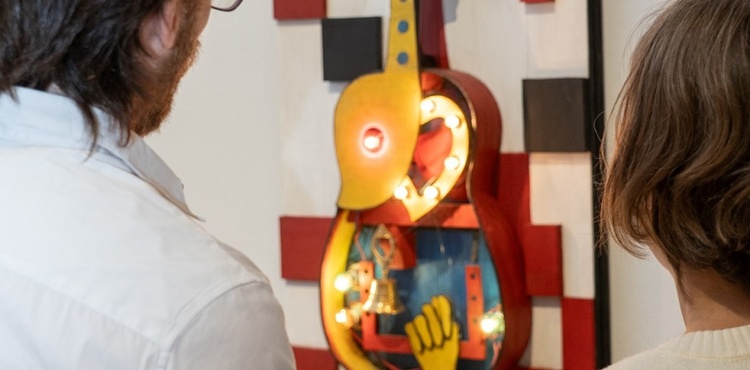
Visiting the exhibition on the second floor of the Malba museum (Museum of Latin American Art of Buenos Aires) is an opportunity to encounter works by Anna Bella Geiger, Antônio Dias, Hélio Oiticica, Rubens Gerchman, Glauco Rodrigues, Claudio Tozzi, Mira Schendel, Wanda Pimentel, among others, and black and white photographs of the dictatorship's events, taken by photographer Evandro Teixeira, and of Chico Buarque, photographed by Claudia Andujar.
In an interview with Clarín in Portuguese, the director of Malba, the Brazilian Rodrigo Moura, who moved to Buenos Aires a few months ago, said that the exhibition ‘Pop Brasil: Avant-garde and New Figuration, 1960-1970’ originated at the Pinacoteca in São Paulo, where it remained for five months until October of this year.
Bob Dylan, in the gaze of Claudio Tozzi. (Photo: Alejandro Guyot, courtesy of Malba press). Pinacoteca de São Paulo
The works in the exhibition at the Pinacoteca were joined by those from the Malba collection and the Costantini collection. Versatility is also one of the aspects of the exhibition and of that period.
“It’s an engaging exhibition, which has that period flavor and attracts both the general public and art specialists,” said Rodrigo Moura. Before assuming the role of artistic director of the museum, Moura, who previously worked as a journalist, was, for six years, the head of curatorship at El Museo del Bairro in New York, which focuses on the art of Latin America and the Caribbean. His career includes MASP (São Paulo Museum of Art) and the Inhotim Institute in Brumadinho, Minas Gerais.
He is the first Brazilian artistic director of Malba and explains the importance of the “Pop Brasil” exhibition. “These are works that challenged the regime and also show other facets of Brazil during that period. The phonographic market, Chacrinha's program, the urbanization of Brasília, the revolution "Of customs, eroticism, women with enormous protagonism, a more egalitarian public space between men and women, counterculture, questioning of bourgeois culture," he comments.
The vitality of the arts in Brazil, the revelation of behaviors and striking facts of Brazilian history are brought together in the exhibition which, as Moura recalled, brings together works about the March of the Hundred Thousand, in June 1968, against the Brazilian military dictatorship, and the artistic occupation of Aterro do Flamengo, in Rio de Janeiro. In other words, unmissable. To understand or remember those sixties and seventies in Brazil.
Source
Latest
Gallery
- December 02, 2025
Gallery of cartoon by Latrache Yassin-France2
News
- December 02, 2025
Exhibition “Unspeakable Gestures,” by Adriano Machado
News
Article
- December 02, 2025
Hélio Oiticica and the Legacy of Brazilian Neo-Concretism
Article
- December 02, 2025
The Relevance of Tarsila do Amaral in Brazilian Modernism
Publications
- December 02, 2025
Animation from Pencils to Pixels: Techniques for the Digital Anima
News
- December 01, 2025
Key Fair for Contemporary Latin American Art
Daily Artwork
- December 01, 2025
Gaza & Sudan
News
- December 02, 2025
Exhibition “Unspeakable Gestures,” by A…

- December 02, 2025
Malba: “Pop Brasil” is an essential exh…
- December 01, 2025
Key Fair for Contemporary Latin America…
- December 01, 2025
Unseen Renoir work resurfaces after a c…
- November 30, 2025
How Brazilian Pop Art Challenged the Di…
- November 30, 2025
Palestinian Artist Transforms War Rubbl…

- November 29, 2025
Latin America's Most Important Craft Fa…

- November 29, 2025
Miami, with a Latin rhythm: the region'…
- November 26, 2025
Frida Kahlo Breaks World Auction Record
- November 23, 2025
Latin American Abstract Painting: From …
- November 23, 2025
Pinta Miami Celebrates 19 Years of Lati…
- November 23, 2025
Upcoming Kahlo auction could fetch up t…
- November 20, 2025
An auction in Bogotá
- November 20, 2025
Klimt Breaks Record at Sotheby’s
- November 19, 2025
Pinta Miami celebrates its 19th edition…

- November 18, 2025
Artists and galleries from Brazil and L…
- November 17, 2025
"Painting in Mexico Today Is More Alive…
- November 17, 2025
Paris Photo Exhibits Iconic Collection …

- November 16, 2025
Art Exhibition in Bogotá
- November 15, 2025
Frida Kahlo's 'The Dream (The Bed)' Exp…

- October 08, 2023
Illustrations reflect the brutal Israel…

- December 25, 2023
The jury statement of the Iran-Brazil F…
- March 21, 2024
The history of art in Palestine

- July 29, 2023
History of Caricature in Brazil

- May 22, 2025
Brady Izquierdo’s Personal Exhibition O…
- September 01, 2023
Neural Filters in new photoshop 2023

- April 20, 2024
Poignant Image of Grief Wins Mohammed S…
- February 18, 2024
7 Ways to Understand What Visual Arts A…
- June 29, 2024
Exhibition at Centro MariAntonia contra…
- May 15, 2024
Eleven murals for Gaza painted across t…

- October 21, 2023
Erick Meyenberg and Tania Ragasol at th…
- August 09, 2023
Venezuela mural expresses solidarity wi…
- March 14, 2024
museum of statue of van gogh
- March 15, 2024
museum of sculpture of Salvador Dali
- March 30, 2024
illustration websites in Latin America
- May 20, 2024
Latin American Festival of Performing A…

- May 25, 2025
Bordalo II to hold exhibition in Paris …
- October 23, 2023
Photos by José Luis Díaz of the march o…
- May 27, 2025
Works by Botero, Grau, and 80 other imp…

- January 23, 2025
Art Palm Beach 2025
- May 15, 2024
Eleven murals for Gaza painted across t…
- February 18, 2024
7 Ways to Understand What Visual Arts A…

- January 02, 2025
13 commemorations that will mark the cu…
- October 17, 2023
The influence of Latin American artists…
- February 03, 2024
THE HISTORY OF NAIF ART
- July 02, 2024
One of the largest urban art galleries …
- October 08, 2023
Illustrations reflect the brutal Israel…

- November 17, 2023
Fernando Botero's work is booming after…
- July 29, 2023
Piracicaba International Humor Exhibiti…
- November 06, 2023
Heba Zagout: Palestinian artist murdere…
- December 25, 2023
The jury statement of the Iran-Brazil F…
- December 10, 2023
Sliman Mansour and Palestinian art on t…
- March 14, 2024
museum of statue of van gogh
- February 01, 2025
A maior exposição de Botero em Barcelona
- March 21, 2024
The history of art in Palestine
- July 20, 2024
First International Mail Art Biennial 2…
- April 20, 2024
Poignant Image of Grief Wins Mohammed S…

- October 30, 2023
Palestinian turns images of the Gaza co…
- September 01, 2023
Neural Filters in new photoshop 2023
- February 08, 2024
Art Week 2024 in CDMX