Graphic Art as Political and Social Expression: The Power of the Dissenting Image
When graphic art abandons its merely decorative or commercial function to become a weapon of denunciation and social transformation, we find ourselves before one of its most powerful manifestations: political graphic art. Throughout history, posters, caricatures, illustrated pamphlets, and murals have been fundamental tools for making injustices visible, confronting power, and mobilizing collective consciousness.
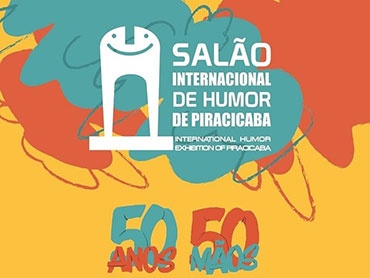
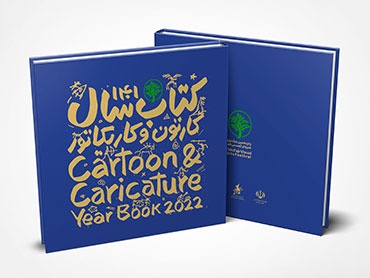
Political caricature, in particular, constitutes one of the oldest and most effective forms of dissenting graphic expression. Its capacity to promote reflection in public spaces, as well as its incitement to confront reality and stimulate knowledge, makes it a true "political weapon against any power that attempts to control institutions and subjugate society." Humorous drawing, by highlighting the farcical side of a situation, manages to overcome cultural and linguistic barriers, facilitating communication between people and even reaching the illiterate population, who perfectly grasp its meaning without needing to know how to read.
The effectiveness of caricature as a tool for propaganda and counter-information was already demonstrated in the French Revolution, when caricaturists from both sides deployed their arsenal of images to engage in a unique iconographic war. "Pencils and burins replaced or complemented sabers," and the political struggle reached the most popular sectors through engravings. In the 19th century, the invention of lithography greatly boosted the dissemination of caricature, allowing for the large-scale reproduction of designs without loss of quality and turning artists like the Frenchman Honoré Daumier or the American Thomas Nast into relentless critics of political corruption and social injustices.
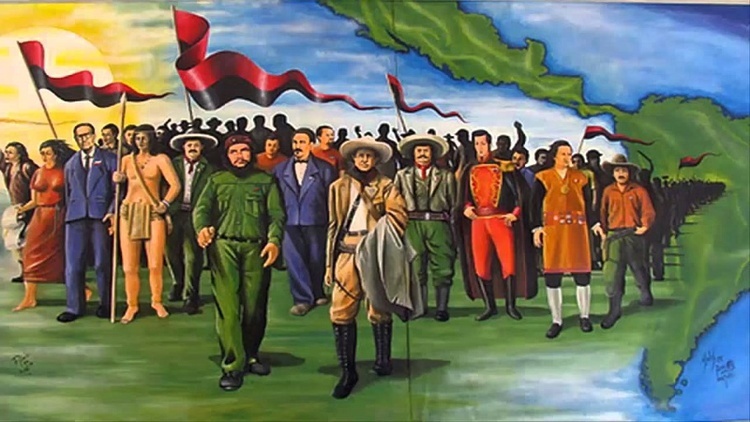
In Latin America, political graphics have had a constant and vibrant presence. During the revolutionary processes and military dictatorships of the 20th century, posters and illustrations became tools of resistance and remembrance. The Ramona Parra Brigade in Chile, for example, incorporated the slogans of the socialist government into an iconographic narrative that shifted the focus from individual painting to the collective walls of the city, amplifying the illustrative and participatory resonance of its direct message. In these contexts, the artist assumed the commitment to put their creativity at the service of the people and the revolution, creating art conceived as an "instrument of cultural agitation" functional to political activism.
Political graphic art is characterized by its "referential explicitness and pedagogical effectiveness." It is not hermetic or self-referential art, but rather art that seeks to "shake the critical conscience of society" through clear, direct messages laden with symbolism. In this sense, the cartoonist acquires the ability to satirically highlight any type of ideological imposition, regardless of its political, religious, social, or economic nature. Their work is a kind of playful, simple, absurd, yet powerful editorial, a vehicle with social and political influence that shapes opinion trends less consciously but perhaps more effectively than traditional political discourse.
Currently, graphic art with social and political content remains relevant, adapting to new digital languages and platforms. The meme, the viral illustration on social media, and the digitally printed street poster continue the tradition of their predecessors: to denounce, to make visible, and to mobilize. The power of the line, combined with culturally rooted symbolic elements, easily establishes the meaning the artist wishes to convey, promoting public opinion and keeping alive the flame of an art that is not content with merely observing the world, but aspires to transform it. Political graphics remind us that, in the hands of a committed artist, a pencil can be as powerful as any other weapon.
Latamarte
Latest
Article
Daily Artwork
Daily Artwork
- February 22, 2026
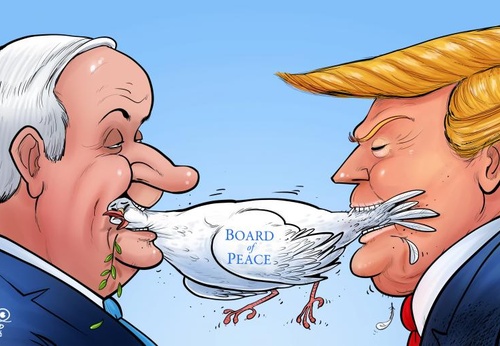
Board of Peace...
Publications
- February 22, 2026
Painting with Watercolour by David Howell
Article
News
- February 21, 2026
Mexico Exhibition: Gelman-Santander Collection of Modern Art
Publications
- February 21, 2026
The Art, Science, and Craft of Great Landscape Photography
Daily Artwork
- February 21, 2026
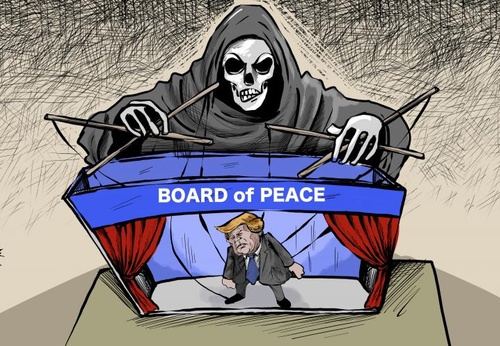
Board of Peace
Article
- February 21, 2026
The Importance of Modern Art in Society
- February 22, 2026
Graphic Art as Political and Social Exp…

- February 22, 2026
Graphic Art as a Builder of Collective …
- February 21, 2026
The Importance of Modern Art in Society
- February 21, 2026
The Birth of Modern Art

- February 19, 2026
Remedios Varo: Alchemical Surrealism in…

- February 19, 2026
Spatialism and Light in the Work of Luc…

- February 18, 2026
Frida Kahlo: The Aesthetics of Pain and…

- February 18, 2026
Tarsila do Amaral's Anthropophagy and B…
- February 17, 2026
Art in the Street: Expression, Resistan…

- February 17, 2026
Most famous male cartoonists in Latin A…

- February 16, 2026
The Art of Caricature: Expression, Humo…
- February 16, 2026
The Art of Caricature in Latin America
- February 15, 2026
Joaquín Torres-García and Constructive …
- February 15, 2026
Mexican Muralism: A Dialogue Between Ar…
- February 14, 2026
Urban and Street Art
- February 14, 2026
Art as the Awakening of the People

- February 12, 2026
Contemporary Printmaking and the Concep…

- February 12, 2026
Graphic design as visual language in co…
- February 10, 2026
The Forging of Modern Mexican Sculpture
- February 10, 2026
The Legacy of the Avant-Garde in Modern…
- August 29, 2023
The history of Bolivian art
- February 19, 2024
Analysis and meaning of Van Gogh's Star…
- January 28, 2024
Culture and Art in Argentina

- September 25, 2023
What is the importance of art in human …

- September 23, 2023
What is paint?

- August 23, 2023
The 11 types of art and their meanings
- August 10, 2023
14 questions and answers about the art …

- September 23, 2023
Painting characteristics
- August 30, 2023
First artistic manifestations
- January 12, 2024
10 most beautiful statues and sculpture…
- September 23, 2023
History of painting
- March 26, 2024
The importance of technology in art1
- March 26, 2024
Cultural identity and its impact on art…

- July 13, 2024
The impact of artificial intelligence o…
- October 18, 2023
History of sculpture
- April 07, 2024
Graffiti in Latin American culture
- December 20, 2024
What is art? Definition, concept and ar…

- April 02, 2024
History visual arts in Brazil
- August 16, 2023
The 15 greatest painters in art history
- April 06, 2024
History of visual arts in Ecuador
- February 19, 2024
Analysis and meaning of Van Gogh's Star…

- August 13, 2023
9 Latino painters and their great contr…
- August 23, 2023
The 11 types of art and their meanings
- August 27, 2023
15 main works of Van Gogh
- August 10, 2023
14 questions and answers about the art …
- August 29, 2023
The history of Bolivian art
- January 28, 2024
Culture and Art in Argentina

- November 06, 2023
5 Latin American artists and their works
- September 23, 2023
Painting characteristics
- September 23, 2023
What is paint?
- September 25, 2023
What is the importance of art in human …
- March 26, 2024
Cultural identity and its impact on art…
- August 30, 2023
First artistic manifestations
- December 18, 2023
10 iconic works by Oscar Niemeyer, geni…
- January 12, 2024
10 most beautiful statues and sculpture…

- January 20, 2024
What is the relationship between art an…

- August 24, 2023
The most famous image of Ernesto "Che" …

- October 30, 2023
Characteristics of Contemporary Art
- August 22, 2023
What are Plastic Arts?
- May 26, 2024
Técnicas de artes visuais