How Artificial Intelligence Is Redefining Art Criticism
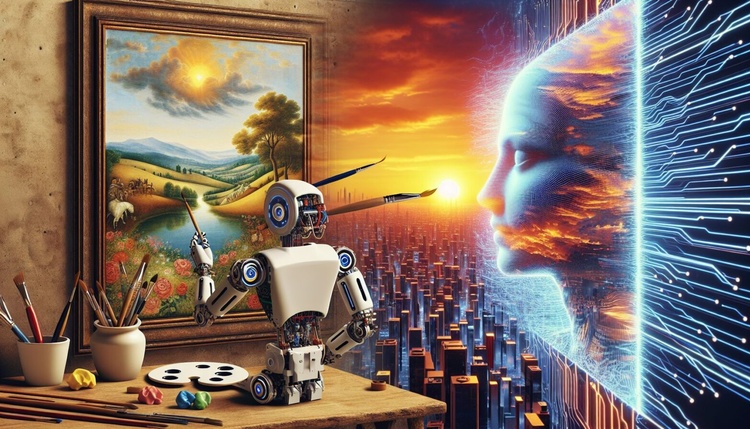
Art criticism has always been a profoundly human territory, anchored in sensitivity, subjective interpretation, and historical-cultural knowledge. However, in recent decades—and more rapidly recently—Artificial Intelligence (AI) has begun to transform this field, raising new possibilities, challenges, and ethical debates. Far from completely replacing the human critic, AI is redefining how art is analyzed, contextualized, and even valued.
1. Art Criticism in the Data Age
Traditionally, art criticism is based on careful observation, aesthetic experience, and the intellectual background of the critic. With AI, a new layer emerges: data-driven analysis. Machine learning algorithms can examine thousands of works simultaneously, identifying stylistic patterns, chromatic recurrences, formal compositions, and historical influences.
For example, computer vision systems can compare a contemporary painting with vast databases of classical and modern works, pointing out aesthetic similarities that might otherwise go unnoticed by the human eye. This does not replace critical interpretation, but it expands the available analytical repertoire.
2. New Forms of Aesthetic Interpretation
AI also introduces unprecedented approaches to the interpretation of art. Instead of relying solely on established aesthetic theories, algorithms can generate readings based on statistical correlations between works, artists, and historical contexts. This "non-human" perspective can reveal unexpected connections, challenging traditional narratives of art history.
At the same time, tools based on natural language processing are able to analyze reviews, artistic manifestos, and curatorial texts, mapping how certain concepts—such as "avant-garde," "rupture," or "identity"—have evolved over time. Thus, criticism ceases to be merely opinion-based and begins to engage with broader discursive trends.
3. Democratization and Access to Criticism
Another significant impact of AI is the democratization of art criticism. Digital platforms with intelligent assistants allow a wider audience to access analyses previously restricted to academic or specialized circles. A museum visitor, for example, can use an app to obtain instant critical commentary on a work, tailored to their level of knowledge.
This broadens the reach of criticism, but also raises questions about superficiality. An automatically generated analysis may lack the emotional depth and critical positioning that characterize great art essays. Still, as an entry point, these tools have a significant educational role.
4. The Transforming Role of the Human Critic
With the increasing presence of AI, the role of the human critic does not disappear—it transforms. Instead of being the sole holder of interpretation, the critic acts as a mediator, curator, and interpreter of the results produced by algorithms. It is up to them to contextualize, question, and, when necessary, disagree with automated readings.
Furthermore, human criticism remains irreplaceable with regard to subjective experience, emotion, and ethical positioning. AI can identify patterns, but it doesn't experience the work, isn't moved by it, nor does it assume cultural or political responsibilities.
5. Ethical Challenges and Limitations
The application of AI in art criticism also brings important challenges. Algorithms are trained from existing data, which means they can reproduce historical biases—privileging Eurocentric canons, already established artists, or certain dominant aesthetics. If not carefully developed, these systems can reinforce inequalities instead of questioning them.
There is also the risk of a standardization of taste, in which algorithmic recommendations excessively influence public reception and the art market. In this scenario, criticism risks becoming predictable, guided by popularity metrics instead of deep reflection.
6. A Future of Collaboration
The future of art criticism seems to point towards a hybrid model, in which humans and machines collaborate. AI offers speed, scale, and new forms of analysis; the human critic brings sensitivity, judgment, and historical awareness. Together, they can build a more pluralistic, informed, and accessible criticism.
Instead of asking whether AI can replace the art critic, the more productive question is: how can it enrich the critical perspective? By accepting AI as a tool—and not as the final arbiter—art criticism can reinvent itself, maintaining its relevance in a world increasingly mediated by technology.
Conclusion
Artificial Intelligence is redefining art criticism by expanding its methodologies, democratizing access, and provoking profound reflections on authorship, interpretation, and aesthetic value. The challenge is not to resist technology, but to integrate it critically and consciously. Thus, art criticism continues to be a space for thought, dialogue, and questioning—now amplified by the possibilities of the digital age.
Latamarte
Latest
Publications
- February 15, 2026
HDR Digital Photography | Dawid Martynowski

Article
- February 15, 2026
Joaquín Torres-García and Constructive Universalism

Article
- February 15, 2026
Mexican Muralism: A Dialogue Between Art and the People

Publications
- February 15, 2026
Watercolor Typography

Gallery
- February 15, 2026
Selected Gallery Of Photography From Brazilian Artists

Gallery
- February 15, 2026
Selected Gallery Of Photography From Brazilian Artists
Publications
News
- February 14, 2026
Remedios Varo and the Enduring Legacy of Her Art in Mexico
Article
- February 14, 2026
Urban and Street Art
- February 15, 2026
Joaquín Torres-García and Constructive …
- February 15, 2026
Mexican Muralism: A Dialogue Between Ar…

- February 14, 2026
Urban and Street Art
- February 14, 2026
Art as the Awakening of the People

- February 12, 2026
Contemporary Printmaking and the Concep…

- February 12, 2026
Graphic design as visual language in co…
- February 10, 2026
The Forging of Modern Mexican Sculpture

- February 10, 2026
The Legacy of the Avant-Garde in Modern…

- February 09, 2026
Fernando Traverso: The Art of Absence a…

- February 09, 2026
Latin American Art and the Palestinian …

- February 08, 2026
Indigenous Artistic Expressions of Lati…

- February 08, 2026
Indigenous Artistic Expressions of Lati…
- February 07, 2026
Muralism in Latin America: The Pictoria…
- February 07, 2026
Painting in Latin America: A Journey of…

- February 03, 2026
Artificial Intelligence and the Reconfi…
- February 02, 2026
10 most expensive Latin American painti…

- February 02, 2026
Importance of visual arts at School

- February 01, 2026
Impressionism and the Revolution of Lig…

- February 01, 2026
The Importance of Urban Art in the Iden…

- January 31, 2026
Artificial Intelligence in Graffiti Art
- August 29, 2023
The history of Bolivian art

- February 19, 2024
Analysis and meaning of Van Gogh's Star…

- January 28, 2024
Culture and Art in Argentina

- September 25, 2023
What is the importance of art in human …

- September 23, 2023
What is paint?

- August 23, 2023
The 11 types of art and their meanings

- August 10, 2023
14 questions and answers about the art …

- September 23, 2023
Painting characteristics
- August 30, 2023
First artistic manifestations

- January 12, 2024
10 most beautiful statues and sculpture…
- September 23, 2023
History of painting

- March 26, 2024
The importance of technology in art1

- July 13, 2024
The impact of artificial intelligence o…
- October 18, 2023
History of sculpture

- March 26, 2024
Cultural identity and its impact on art…
- April 07, 2024
Graffiti in Latin American culture

- December 20, 2024
What is art? Definition, concept and ar…
- August 16, 2023
The 15 greatest painters in art history

- April 06, 2024
History of visual arts in Ecuador

- April 02, 2024
History visual arts in Brazil
- February 19, 2024
Analysis and meaning of Van Gogh's Star…

- August 13, 2023
9 Latino painters and their great contr…
- August 23, 2023
The 11 types of art and their meanings

- August 27, 2023
15 main works of Van Gogh
- August 10, 2023
14 questions and answers about the art …
- August 29, 2023
The history of Bolivian art
- January 28, 2024
Culture and Art in Argentina
- November 06, 2023
5 Latin American artists and their works
- September 23, 2023
Painting characteristics
- September 23, 2023
What is paint?
- September 25, 2023
What is the importance of art in human …
- March 26, 2024
Cultural identity and its impact on art…
- August 30, 2023
First artistic manifestations

- December 18, 2023
10 iconic works by Oscar Niemeyer, geni…
- January 12, 2024
10 most beautiful statues and sculpture…

- January 20, 2024
What is the relationship between art an…

- August 24, 2023
The most famous image of Ernesto "Che" …

- October 30, 2023
Characteristics of Contemporary Art

- August 22, 2023
What are Plastic Arts?

- May 26, 2024
Técnicas de artes visuais