Pinta Miami Highlights Sustainable Latin American Art During Art Week
Pinta Miami Focuses on Sustainable Latin American Art During Art Week
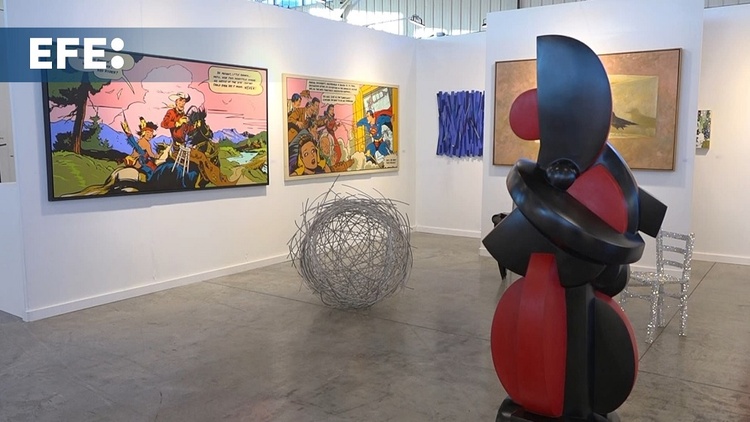
Miami (USA), Dec 4 (EFE) – The Pinta Miami art fair is showcasing Latin American art at its usual venue in Coconut Grove, Miami, starting Thursday. This year's fair features a selection of environmentally friendly works, as well as creations by artists from Central America.
The fair, which takes place during Miami Art Week, specializes in Latin American art and will exhibit the works of more than 100 artists, presented by nearly 40 galleries from 14 countries.
Among the most noteworthy works are a sculpture by Colombian artist Ricardo Cárdenas honoring mangroves – a natural barrier against flooding and erosion – a collection of photographs on poetry from the Salvadoran gallery Matía Borgonovo, and a visual light installation by Argentinian artist Paul Sende.
Among the most noteworthy works are a sculpture by Colombian artist Ricardo Cárdenas honoring mangroves—a natural barrier against flooding and erosion—a collection of photographs on poetry from the Salvadoran gallery Matía Borgonovo, and a visual light installation by Argentinian artist Paul Sende.
Others include positive short stories from the Argentinian gallery AMIA and a challenge to trypophobia (the fear of looking at closely spaced geometric shapes) in the form of an anthropomorphic sculpture composed of hundreds of small, multicolored circles, created by Puerto Rican artist Naimar Ramírez.
"This year we have a strong presence of galleries from Central America and artists who work with textiles, and everything related to the land and indigenous cultures," Irene Gelfman, artistic director of Pinta Miami, told EFE.
Visitors can view all kinds of pieces related to Latin American culture until Sunday, pieces that invite reflection, showcase bold color contrasts, and offer a platform for emerging talent.
One of the main novelties of the 19th edition of this fair is the inclusion of several more environmentally friendly works, according to Gelfman.
"There's a lot of textiles, quite a bit of ceramics and painting," Gelfman described, asserting that the art scene is experiencing "a wake-up call" regarding its relationship with the environment, given that some widely used techniques, such as acrylics, are toxic.
This is the case with Spanish artist Paloma de la Cruz, who is presenting four ceramic and textile works related to Quetzalcoatl and other ancestral representations, and with Guatemalan artist Sandra Monterroso, who works with natural pigments to reduce this type of pollution.
Pinta Miami is one of the three annual stops of this fair, which is also held each year in Lima and Buenos Aires and serves as a barometer for understanding the state of Latin American art in the world.
A position that, according to the fair's general curator, is becoming increasingly relevant. In addition to the main section, Pinta Miami features other selections such as Radar, which brings together artists presenting less polluting works developed with organic materials.
Among these works are creations by De la Cruz and prints of natural elements related to Brazilian indigenous culture.
Another parallel section is Next, dedicated to experimental proposals and comprised of four duos of artists and galleries from different countries and generations.
One of the artists is Gabriela Esplá from Panama, who questions the care of nature with her scenes of dense and emotive jungles, in which she denounces their neglect.
The fair also includes a space for reflection in the form of the Pinta Miami 2025 FORUM, where experts and industry leaders will discuss the current state of the Latin American art market.
It will also include a series of performances in which artists, through movement, invite the public to reflect on the role of the body in understanding the external world.
Gelfman indicated that all of this constitutes "a boutique fair with a very friendly scale and standard" that sets it apart from the other fairs that coincide with Miami Art Week.
The goal for the next five years, he continued, is for Pinta Miami "to be on the agenda of everyone who wants to know what's happening with Latin America and Latin American artists."
Source
Latest

Publications
- January 27, 2026
Aztecs in the Empire City: “The People Without History” in The Met

News

Article
- January 27, 2026
The Evolution of Art: From Classical to Digital

Article
- January 27, 2026
What are Visual Arts and Why Do They Matter Today?

Gallery
- January 27, 2026
Selected Illustration Gallery of Venezuelan Artists

Gallery
- January 27, 2026
Selected Caricature Gallery of Cuban Artists
Publications
- January 26, 2026
Bolivia Poster Biennial (BICeBé 2013)
Gallery
- January 26, 2026
Selected Gallery of Paintings by Peruvian Artists

Gallery
- January 26, 2026
Selected Gallery of Watercolor Paintings by Peruvian Artists

- January 27, 2026
The exhibitions "From Tàpies to Siqueir…

- January 19, 2026
The Pulse of Art, Design, and Culture R…
- January 19, 2026
The Argentine museum celebrates 25 year…

- January 08, 2026
Latin American Pavilion Among the New A…

- January 07, 2026
Material Art Fair 2026

- January 05, 2026
The Latin American Pavilion Marks a Mil…
- December 31, 2025
the 10 million-dollar sales of 2025
- December 30, 2025
MALBA Doubles Collection and Reposition…
- December 29, 2025
The FEMSA Collection will celebrate its…

- December 25, 2025
“Ancestral Artist”: A Look at the Craft…

- December 25, 2025
Winner of the 13th Most Important Conte…
- December 25, 2025
Malba Acquires the Daros Latinamerica C…
- December 24, 2025
2026, a Key Year in Cultural Exchange B…

- December 23, 2025
Sacred Art Celebrates Christmas Through…
- December 22, 2025
MACA Inaugurates Exhibitions of Fontana…
- December 20, 2025
Costantini Acquires the Daros Collectio…
- December 17, 2025
ARCOmadrid Announces Participating Gall…
- December 17, 2025
Eduardo Costantini Acquired a Collectio…

- December 15, 2025
From Chile to Gaza: «Palestine Cries,»
- December 15, 2025
Latin American Artists MACLA and Montal…

- October 08, 2023
Illustrations reflect the brutal Israel…

- December 25, 2023
The jury statement of the Iran-Brazil F…

- March 21, 2024
The history of art in Palestine

- July 29, 2023
History of Caricature in Brazil

- September 01, 2023
Neural Filters in new photoshop 2023

- April 20, 2024
Poignant Image of Grief Wins Mohammed S…

- May 22, 2025
Brady Izquierdo’s Personal Exhibition O…
- June 29, 2024
Exhibition at Centro MariAntonia contra…
- February 18, 2024
7 Ways to Understand What Visual Arts A…

- October 21, 2023
Erick Meyenberg and Tania Ragasol at th…

- May 15, 2024
Eleven murals for Gaza painted across t…
- March 30, 2024
illustration websites in Latin America
- August 09, 2023
Venezuela mural expresses solidarity wi…

- March 14, 2024
museum of statue of van gogh

- May 25, 2025
Bordalo II to hold exhibition in Paris …
- March 15, 2024
museum of sculpture of Salvador Dali

- May 20, 2024
Latin American Festival of Performing A…

- January 23, 2025
Art Palm Beach 2025
- March 18, 2025
Works by Cuban Artist Eduardo Abela in …

- January 04, 2025
Material Art Fair 2025
- May 15, 2024
Eleven murals for Gaza painted across t…
- February 18, 2024
7 Ways to Understand What Visual Arts A…

- January 02, 2025
13 commemorations that will mark the cu…
- October 17, 2023
The influence of Latin American artists…
- February 03, 2024
THE HISTORY OF NAIF ART

- July 02, 2024
One of the largest urban art galleries …

- November 17, 2023
Fernando Botero's work is booming after…
- October 08, 2023
Illustrations reflect the brutal Israel…
- July 29, 2023
Piracicaba International Humor Exhibiti…
- December 25, 2023
The jury statement of the Iran-Brazil F…
- November 06, 2023
Heba Zagout: Palestinian artist murdere…

- December 10, 2023
Sliman Mansour and Palestinian art on t…
- March 14, 2024
museum of statue of van gogh

- February 01, 2025
A maior exposição de Botero em Barcelona
- March 21, 2024
The history of art in Palestine
- July 20, 2024
First International Mail Art Biennial 2…
- April 20, 2024
Poignant Image of Grief Wins Mohammed S…

- October 30, 2023
Palestinian turns images of the Gaza co…
- September 01, 2023
Neural Filters in new photoshop 2023

- February 08, 2024
Art Week 2024 in CDMX