“GENOCIDE” Exhibition and Controversy Over Hate Crime Allegations in Madrid
An exhibition features three works critical of Israel that were denounced as hate crimes by ACOM (Association of Women Artists of the Americas)
The “GENOCIDE” exhibition, which aims to offer an artistic response to attempts to silence solidarity with Palestine, presents works by 40 artists in Madrid. Three of the pieces were accused last year of antisemitism and hate crimes by a Zionist pressure group and the Movement Against Intolerance.
The collective exhibition “GENOCIDE” opens in Madrid on Saturday, December 13, featuring works by 40 artists that denounce the massacre committed in Gaza by the State of Israel. The exhibition, which can be visited at the Anselmo Lorenzo Foundation until January 13, aims to offer an artistic response to attempts to silence solidarity with Palestine. Three of the artists featured in the exhibition have personally experienced one of these attempts.
Last November, the political organization Action and Communication on the Middle East (ACOM) and the Movement Against Intolerance filed a complaint against artists Sebas Cabero, Nuria Güell, and Byron Maher, designer of El Salto, for an alleged hate crime. The complaint stemmed from three works that were briefly displayed on the facade of the La Rosa Squatted Social Center in Madrid. The pieces were part of a contemporary art group exhibition titled "Rabia mierda" (Rage Shit), comprised of works that conveyed "provocative and challenging messages, intended to question the status quo and promote social change," according to its catalog.
On November 7, during the installation of the exhibition, Güell's work was photographed and posted by a user on the social network X, without any context or explanation. The post received an immediate reaction from ACOM, which labeled it "anti-Semitic."
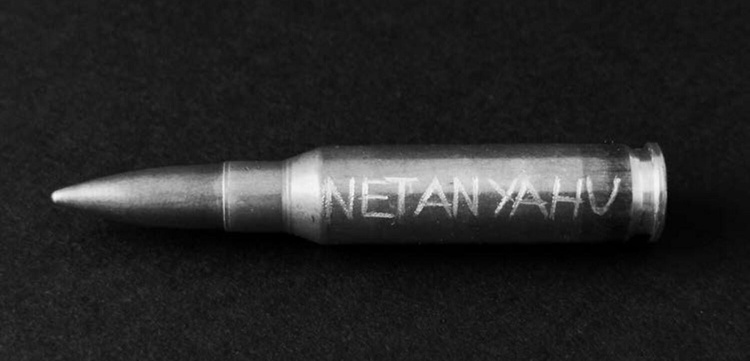
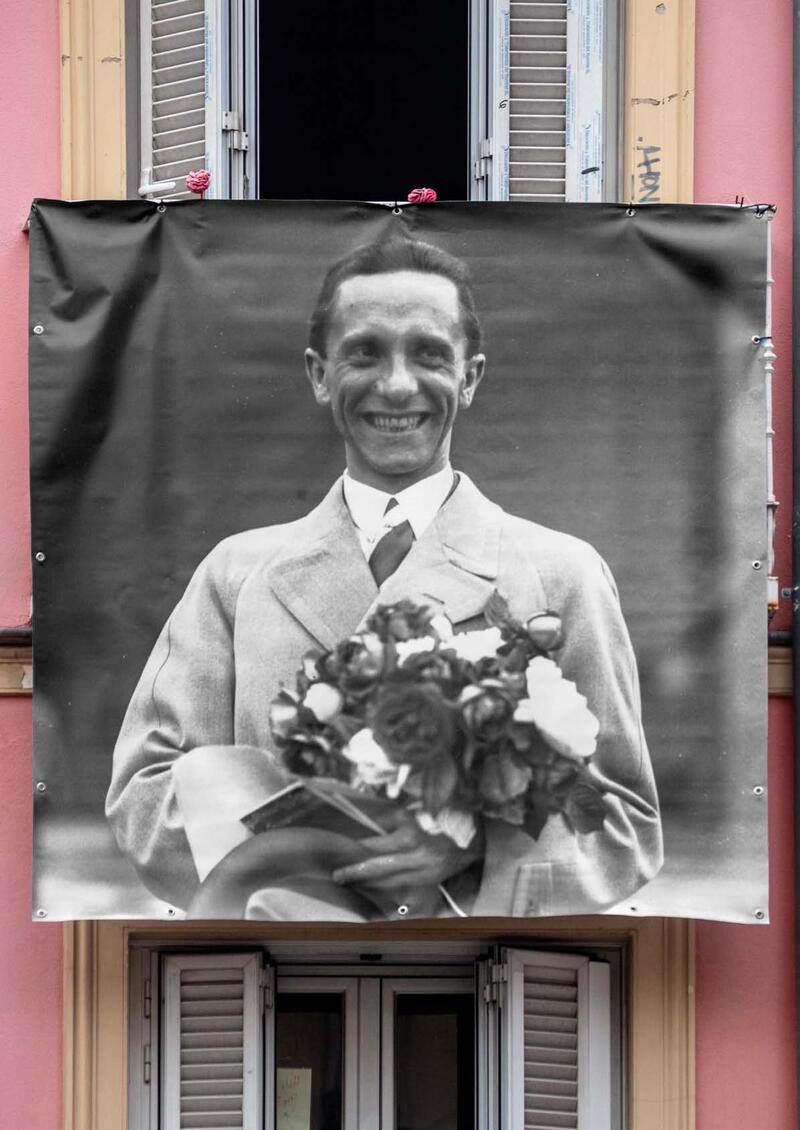
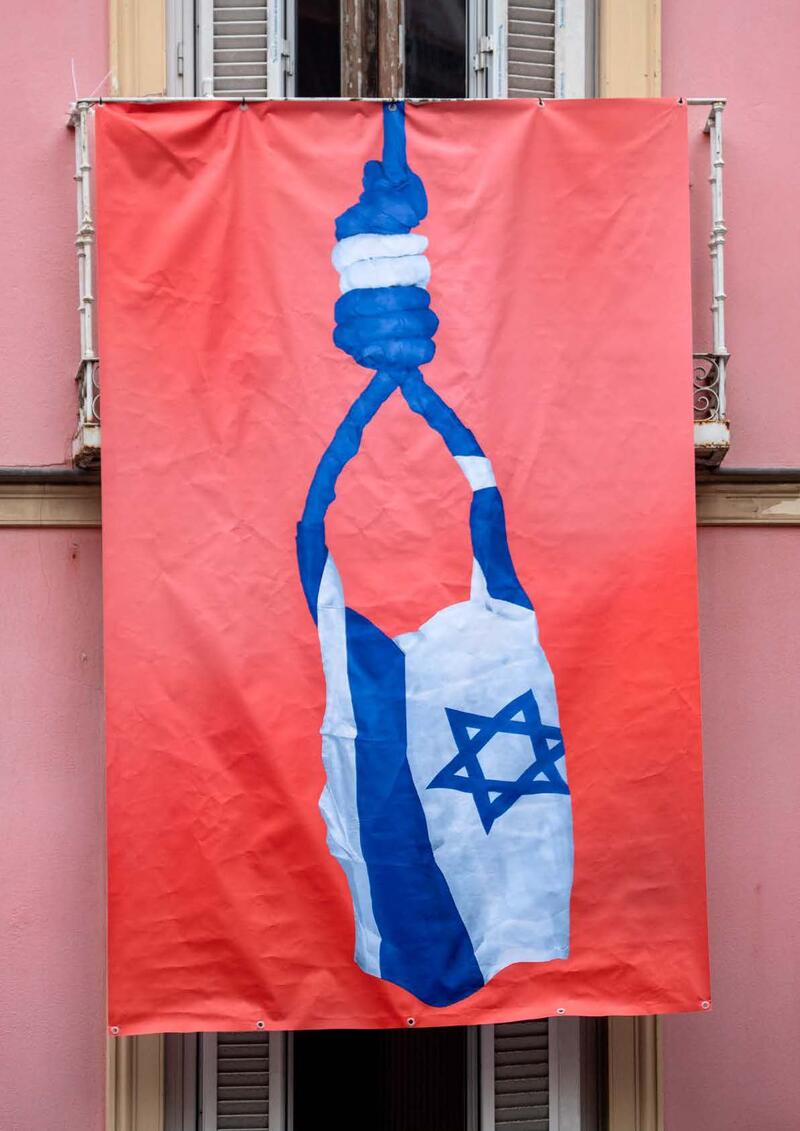
On November 8, a few hours before the opening, Cabero went to La Rosa and displayed the images so they could be photographed and included in the exhibition's digital catalog, which was available throughout the exhibition and could be downloaded via a QR code. A Telemadrid news crew filmed the works and broadcast a report claiming that squatters were displaying a photograph of Goebbels, a bullet bearing Netanyahu's name, and a rope made from the Israeli flag at La Rosa. The report stated that the exhibition was causing unease and concern within Madrid's Jewish community, and Esteban Ibarra, president of the Movement Against Intolerance, announced that it would be reported as a hate crime.
That same morning, Cabero was photographed by an officer from the Provincial Information Brigade of the National Police Corps while displaying the works on the building's facade. Given the uproar, all the participating artists decided to remove the artwork to avoid damaging the space.
For Raúl Maíllo, the lawyer for one of the accused artists, this process will end with the case being dismissed because “clearly” there is no hate crime, since “there is no action against any specific group.”
The threat of legal action announced by Ibarra was confirmed shortly afterward and the case was accepted for processing. In the police report, the three works are listed as being investigated for an alleged hate crime. In June 2025, the National Police went to Cabero's home and served him with a court summons to appear on that date as a suspect before the Court of Instruction number 52 in Madrid. The artist's lawyer requested the dismissal of the case, which has not yet occurred. According to Raúl Maíllo, the lawyer for another of the accused artists, everything suggests that this process will end with the case being dismissed because “clearly” there is no hate crime, since “there is no action against any specific group.” What the works do show, the lawyer points out, is a critique of an action by the State of Israel, but “that doesn’t meet any of the criteria for a hate crime.”
In a joint statement, the artists clarify that none of the three works aims to “promote, encourage, or publicly incite hatred, hostility, discrimination, or violence against any group or person based on their origin, religion, ethnicity, or ideology.” Rather, they assert, they are artistic and visual critiques of current social and political events, in whose creation they employed “visually impactful techniques designed to capture the public’s attention, such as irony and visual metaphor.”
Cabero's piece, titled "The Solution?", aims to raise questions about the legitimacy of violence in conflict resolution. Güell's work, "Counter-Propaganda," disseminates the image and political propaganda tactics of Paul Joseph Goebbels, with which he monopolized the state media apparatus of the Third Reich and controlled the cultural and intellectual life of Germany. The artist's objective with this piece is "to make these strategies visible as a first step to neutralizing their effectiveness in times of post-truth, to highlight historical parallels, and to enable critical reflection on the manipulation of information carried out according to the interests of different powers and their lobbies today." As for Maher's creation, "States of Israel," it is a work that forms part of a broader project that questions the repression and violence that states exert on bodies through the flag as their most significant symbol. The piece takes the form of a metaphorical game in which the ‘gallows,’ made with the symbol of the flag, represents “the suffocation, the strangulation, and the repression exerted by states through their necropolitics.”
The three works will be on display in GENOCIDE, whose catalog states that the exhibition aims to “challenge, make visible, and resist what governments, institutions, and the media attempt to delegitimize.” The exhibition text clarifies that “criticizing the policies of the State of Israel is not antisemitism; this is denounced by numerous Jews, activists, and intellectuals both inside and outside Israel,” and laments the use of laws and regulations to “censor pro-Palestinian activism, art, and protests.”
Maíllo believes that the status of a work as art should broaden the scope of freedom of expression. “Artistic works cannot be subject to prior censorship or to the supposed sensibilities of the recipients who intend to censor them. It cannot depend on whether ACOM or the Movement Against Intolerance finds them offensive; it must be examined within the parameters of an objective character of the offensive intent and hate crime, which is an added aggravating factor against a group,” explains the lawyer, who adds that the three works in question present “a critique of the genocidal actions of a State, which international standards and organizations are recognizing as such.”
In his opinion, what has happened is part of a “coordinated and organized” strategy by ACOM, which consists of filing complaints against any person or entity that questions the actions of the State of Israel and that tries in one way or another to oppose the genocide. “Those who have expressed a journalistic, political, or artistic position have faced complaints that, in many cases, go nowhere; in some instances, proceedings are initiated, regardless of whether they ultimately amount to nothing. But you're already facing legal proceedings, suffering the anxiety of what might happen when all you've done is exercise your freedom of expression to oppose a genocide,” Maíllo explains.
The consequences of this approach by the pressure group are predictable. On the one hand, self-censorship among artists, journalists, and analysts who address the situation in Israel and Palestine. And on the other, according to the lawyer, the development of “a legal sensibility that confuses a hate crime against Judaism, or even against the State of Israel, with legitimate political or artistic criticism and the advocacy of international standards upheld by the United Nations and its agencies.”
What is ACOM?
ACOM is the main tool of cultural warfare for Zionism in Spain, employing agitation and propaganda. Public information about this association is scarce, although businessman David Hatchwell is named as its co-founder and Ángel Mas, CEO of the insurance company Amtrust, serves as president and writes articles for publications such as Libertad Digital and Voz Pópuli.
Source
Latest

News

Article
- January 27, 2026
The Evolution of Art: From Classical to Digital

Article
- January 27, 2026
What are Visual Arts and Why Do They Matter Today?

Gallery
- January 27, 2026
Selected Illustration Gallery of Venezuelan Artists

Gallery
- January 27, 2026
Selected Caricature Gallery of Cuban Artists
Publications
- January 26, 2026
Bolivia Poster Biennial (BICeBé 2013)
Gallery
- January 26, 2026
Selected Gallery of Paintings by Peruvian Artists

Gallery
- January 26, 2026
Selected Gallery of Watercolor Paintings by Peruvian Artists

Article
- January 26, 2026
First artistic manifestations

- January 27, 2026
The exhibitions "From Tàpies to Siqueir…

- January 19, 2026
The Pulse of Art, Design, and Culture R…
- January 19, 2026
The Argentine museum celebrates 25 year…

- January 08, 2026
Latin American Pavilion Among the New A…

- January 07, 2026
Material Art Fair 2026

- January 05, 2026
The Latin American Pavilion Marks a Mil…
- December 31, 2025
the 10 million-dollar sales of 2025
- December 30, 2025
MALBA Doubles Collection and Reposition…
- December 29, 2025
The FEMSA Collection will celebrate its…

- December 25, 2025
“Ancestral Artist”: A Look at the Craft…

- December 25, 2025
Winner of the 13th Most Important Conte…
- December 25, 2025
Malba Acquires the Daros Latinamerica C…
- December 24, 2025
2026, a Key Year in Cultural Exchange B…

- December 23, 2025
Sacred Art Celebrates Christmas Through…
- December 22, 2025
MACA Inaugurates Exhibitions of Fontana…
- December 20, 2025
Costantini Acquires the Daros Collectio…
- December 17, 2025
ARCOmadrid Announces Participating Gall…
- December 17, 2025
Eduardo Costantini Acquired a Collectio…

- December 15, 2025
From Chile to Gaza: «Palestine Cries,»

- December 15, 2025
Latin American Artists MACLA and Montal…

- October 08, 2023
Illustrations reflect the brutal Israel…

- December 25, 2023
The jury statement of the Iran-Brazil F…
- March 21, 2024
The history of art in Palestine

- July 29, 2023
History of Caricature in Brazil

- September 01, 2023
Neural Filters in new photoshop 2023
- April 20, 2024
Poignant Image of Grief Wins Mohammed S…
- May 22, 2025
Brady Izquierdo’s Personal Exhibition O…
- June 29, 2024
Exhibition at Centro MariAntonia contra…
- February 18, 2024
7 Ways to Understand What Visual Arts A…

- October 21, 2023
Erick Meyenberg and Tania Ragasol at th…
- May 15, 2024
Eleven murals for Gaza painted across t…
- March 30, 2024
illustration websites in Latin America
- August 09, 2023
Venezuela mural expresses solidarity wi…
- March 14, 2024
museum of statue of van gogh

- May 25, 2025
Bordalo II to hold exhibition in Paris …
- March 15, 2024
museum of sculpture of Salvador Dali
- May 20, 2024
Latin American Festival of Performing A…

- January 23, 2025
Art Palm Beach 2025
- March 18, 2025
Works by Cuban Artist Eduardo Abela in …
- January 04, 2025
Material Art Fair 2025
- May 15, 2024
Eleven murals for Gaza painted across t…
- February 18, 2024
7 Ways to Understand What Visual Arts A…

- January 02, 2025
13 commemorations that will mark the cu…
- October 17, 2023
The influence of Latin American artists…
- February 03, 2024
THE HISTORY OF NAIF ART

- July 02, 2024
One of the largest urban art galleries …

- November 17, 2023
Fernando Botero's work is booming after…
- October 08, 2023
Illustrations reflect the brutal Israel…
- July 29, 2023
Piracicaba International Humor Exhibiti…
- December 25, 2023
The jury statement of the Iran-Brazil F…
- November 06, 2023
Heba Zagout: Palestinian artist murdere…
- December 10, 2023
Sliman Mansour and Palestinian art on t…
- March 14, 2024
museum of statue of van gogh
- February 01, 2025
A maior exposição de Botero em Barcelona
- March 21, 2024
The history of art in Palestine

- July 20, 2024
First International Mail Art Biennial 2…
- April 20, 2024
Poignant Image of Grief Wins Mohammed S…

- October 30, 2023
Palestinian turns images of the Gaza co…
- September 01, 2023
Neural Filters in new photoshop 2023

- February 08, 2024
Art Week 2024 in CDMX