Brazilian Artist's Exhibitions at the Vatican
Vatican: Exhibitions by Brazilian artist highlight Latin American social struggles
Two exhibitions by Jonathas de Andrade speak of the union of spirituality, the Gospel, and the struggles for social causes during one of the most turbulent periods in Latin America: the 1960s and 1970s, when the countries of the region were under dictatorial regimes. More than a rescue of the past, it is a reflection on the same problems – poverty and the lack of access to the most basic rights – that are prevalent in the social dynamics of today.
Mariane Rodrigues – Vatican News
“As Pope Leo says in his apostolic exhortation – Dilexi te – we have not yet done enough to illuminate the structural and social causes of poverty in the world. And that is what Jonathas de Andrade reflects on.” These are the words of Cardinal José Tolentino de Mendonça, Prefect of the Dicastery for Culture and Education, in defining the two exhibitions by the Brazilian artist – a native of Maceió – which dialogue with each other and portray the history of collective and social engagements of Latin American movements, connecting them with art and spirituality through Liberation Theology, a Catholic current that emerged in Latin America in the 1960s, with engagement in the struggle for the care of the poor.
The exhibitions, presented at the Concilizione 5 space and at the Macro – Museum of Contemporary Art in Rome – are part of the Holy See's contemporary art program for the Jubilee 2025. They not only highlight the efforts of social movements to address the social needs that afflicted society during that period – which took place amidst totalitarian regimes in Latin America – but also present contemporary reflections, acknowledging that these same problems persist today within current social dynamics, requiring constant attention and confrontation in the search for solutions to these issues, such as poverty and the lack of access to the most basic rights it entails, such as education.
“This work speaks to the social dimension of conversion. It is true that each pilgrim makes an individual journey – we are called to a conversion in the first person singular – but it is also true that we must seek a communal conversion – because every cause – we think of war, inequality, violence – is also structural. And the Jubilee is also an opportunity for a call to public debate, involving various political, social, and cultural actors, for a reflection that helps to humanize our society and to bring the spirit of the Gospel to the dynamism of our lives, to this present moment of history,” emphasizes Tolentino.
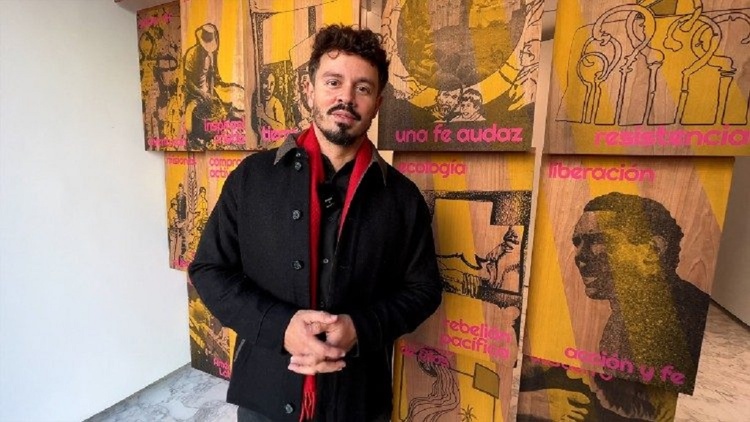
In the Conciliazione 5 space, Jonathas de Andrade presents his silkscreen prints on wood to construct a narrative and, from it, restore the communal spirit of Latin American movements engaged in the struggle for the most vulnerable in society, such as the Catholic current of Liberation Theology. On each panel, it is possible to read words in Spanish such as "resistencia" (resistance), "caridad" (charity), "fe audaz" (bold faith), "educación" (education), "inspiración cristiana" (Christian inspiration), "ecología" (ecology), among others. The curator is Cristiana Perrella. This exhibition is called "Capela della Liberazione" (Chapel of Liberation).
"Perhaps the panel with the word 'education' is a special one for us, because education is truly a way of building social justice, and the Holy Father Leo XIV also speaks abundantly about this. For the Church, the education of the poor is not an eventuality, it is a duty that the Church has always embraced, because this option for the education of the popular classes and the most vulnerable sectors of our society is something that has been at the heart of the Church throughout the centuries, and also today in our present," expresses the Prefect of the Dicastery for Culture and Education, the creator of the artistic project.
This work connects with another – this time audiovisual – that portrays the story of a community of nuns who, in the 1960s, when Brazil was under a military dictatorship, engaged in political and social actions, uniting them with spirituality. The production, entitled “Sorelle senza nome” (“Nameless Sisters”), is a 20-minute film produced by the Brazilian artist with support from the In Between Art Film Foundation and is on display at Macro until April 6, 2026.
The Nameless Nuns
The sisters were part of a community of nuns who were threatened by the military dictatorship because of their involvement with social causes marked by spirituality, the gospel, and support for the less fortunate. They had to move to Rome to escape the regime. It was from the Eternal City that they continued their missions, but anonymously, in favor of the oppressed.
“Producing this film was both an emotional and a responsible experience. Because it’s a story that is both personal and of great historical relevance. This film, in some way, touches on the importance of keeping alive the memory of these stories of resistance against dictatorships, against totalitarian regimes in Latin America, and of all the consequences for so many lives lost,” reflects Jonathas de Andrade.
He explains that the lives of these sisters – 35 of them – represent a “very beautiful and relevant intersection” with the Catholic Church, through Liberation Theology, “which was very strong both in Brazil and throughout Latin America,” he adds.
In the film, the viewer will see testimonies, their voices, images of them handling photographs, details of their house, them gathered together praying, but never one of them speaking directly to the camera.
“These are stories of resistance that will always inspire us and remind us of the importance of keeping the flame of memory alive. My expectation is that the film will be moving and meaningful for the women’s community and their network,” the artist points out.
For Tolentino, the exhibition aims to be a message of the Jubilee.
“This exhibition by Jonathas Andrade offers us this reflection, this metaphor, which arises from a visit to archives, to publications of the Latin American Church in the 60s and 70s, and he transports this image that has an aesthetic, we can say, that is very historicized, but which offers a possibility of reflection on the present. The recent past is always a challenge to illuminate the issues and paths of our historical present,” explains Tolentino.
Jubilee Exhibitions
The two exhibitions by Jonathas de Andrade are part of the fourth and final meeting held at the Conciliazione 5 space. The venue, located near St. Peter's Basilica, on the occasion of the Jubilee 2025, is dedicated to themes that are in line with the Apostolic Exhortation Dilexi te, published by Pope Leo XIV, which reflects on solidarity and social commitment. These exhibitions also connect to the issues addressed by the Jubilee 2025, such as prisons, migration, the environment, and poverty.
This is a contemporary art project initiated by the Dicastery for Culture and Education of the Holy See.
Before Jonathas de Andrade, there were three other exhibitions of this kind by other artists, all curated by Cristiana Perrella. The first was Yan Pei-Ming, from Shanghai, China, who addressed the prison condition, specifically the community of the Regina Coeli prison, located in Rome. The second was Adrian Paci, from Shkodër, Albania, who exhibited on the transformative power of travel. The third exhibition was by Vivian Suter, from Buenos Aires, Argentina, who explored the relationship between man and nature.
Source
Latest
Article
- January 28, 2026
Globalization and New Discourses in Contemporary Latin American Art
Article
- January 28, 2026
Contemporary Art in Latin America

Publications
- January 27, 2026
Aztecs in the Empire City: “The People Without History” in The Met

News

Article
- January 27, 2026
The Evolution of Art: From Classical to Digital

Article
- January 27, 2026
What are Visual Arts and Why Do They Matter Today?

Gallery
- January 27, 2026
Selected Illustration Gallery of Venezuelan Artists

Gallery
- January 27, 2026
Selected Caricature Gallery of Cuban Artists
Publications
- January 26, 2026
Bolivia Poster Biennial (BICeBé 2013)

- January 27, 2026
The exhibitions "From Tàpies to Siqueir…

- January 19, 2026
The Pulse of Art, Design, and Culture R…
- January 19, 2026
The Argentine museum celebrates 25 year…

- January 08, 2026
Latin American Pavilion Among the New A…
- January 07, 2026
Material Art Fair 2026
- January 05, 2026
The Latin American Pavilion Marks a Mil…
- December 31, 2025
the 10 million-dollar sales of 2025
- December 30, 2025
MALBA Doubles Collection and Reposition…
- December 29, 2025
The FEMSA Collection will celebrate its…

- December 25, 2025
“Ancestral Artist”: A Look at the Craft…

- December 25, 2025
Winner of the 13th Most Important Conte…
- December 25, 2025
Malba Acquires the Daros Latinamerica C…
- December 24, 2025
2026, a Key Year in Cultural Exchange B…

- December 23, 2025
Sacred Art Celebrates Christmas Through…
- December 22, 2025
MACA Inaugurates Exhibitions of Fontana…
- December 20, 2025
Costantini Acquires the Daros Collectio…
- December 17, 2025
ARCOmadrid Announces Participating Gall…
- December 17, 2025
Eduardo Costantini Acquired a Collectio…

- December 15, 2025
From Chile to Gaza: «Palestine Cries,»
- December 15, 2025
Latin American Artists MACLA and Montal…

- October 08, 2023
Illustrations reflect the brutal Israel…
- December 25, 2023
The jury statement of the Iran-Brazil F…
- March 21, 2024
The history of art in Palestine

- July 29, 2023
History of Caricature in Brazil
- September 01, 2023
Neural Filters in new photoshop 2023
- April 20, 2024
Poignant Image of Grief Wins Mohammed S…

- May 22, 2025
Brady Izquierdo’s Personal Exhibition O…
- June 29, 2024
Exhibition at Centro MariAntonia contra…

- October 21, 2023
Erick Meyenberg and Tania Ragasol at th…
- February 18, 2024
7 Ways to Understand What Visual Arts A…
- May 15, 2024
Eleven murals for Gaza painted across t…
- March 30, 2024
illustration websites in Latin America
- August 09, 2023
Venezuela mural expresses solidarity wi…
- March 14, 2024
museum of statue of van gogh

- May 25, 2025
Bordalo II to hold exhibition in Paris …
- March 15, 2024
museum of sculpture of Salvador Dali
- May 20, 2024
Latin American Festival of Performing A…

- January 23, 2025
Art Palm Beach 2025
- March 18, 2025
Works by Cuban Artist Eduardo Abela in …
- January 04, 2025
Material Art Fair 2025
- May 15, 2024
Eleven murals for Gaza painted across t…
- February 18, 2024
7 Ways to Understand What Visual Arts A…
- January 02, 2025
13 commemorations that will mark the cu…
- October 17, 2023
The influence of Latin American artists…
- February 03, 2024
THE HISTORY OF NAIF ART
- July 02, 2024
One of the largest urban art galleries …

- November 17, 2023
Fernando Botero's work is booming after…
- October 08, 2023
Illustrations reflect the brutal Israel…
- July 29, 2023
Piracicaba International Humor Exhibiti…
- December 25, 2023
The jury statement of the Iran-Brazil F…
- November 06, 2023
Heba Zagout: Palestinian artist murdere…
- December 10, 2023
Sliman Mansour and Palestinian art on t…
- March 14, 2024
museum of statue of van gogh
- February 01, 2025
A maior exposição de Botero em Barcelona
- March 21, 2024
The history of art in Palestine
- July 20, 2024
First International Mail Art Biennial 2…
- April 20, 2024
Poignant Image of Grief Wins Mohammed S…

- October 30, 2023
Palestinian turns images of the Gaza co…
- September 01, 2023
Neural Filters in new photoshop 2023
- February 08, 2024
Art Week 2024 in CDMX