The Latin American Pavilion Marks a Milestone at the LA Art Show
The Latin American Pavilion at the LA Art Show will highlight the creative achievements of our community.
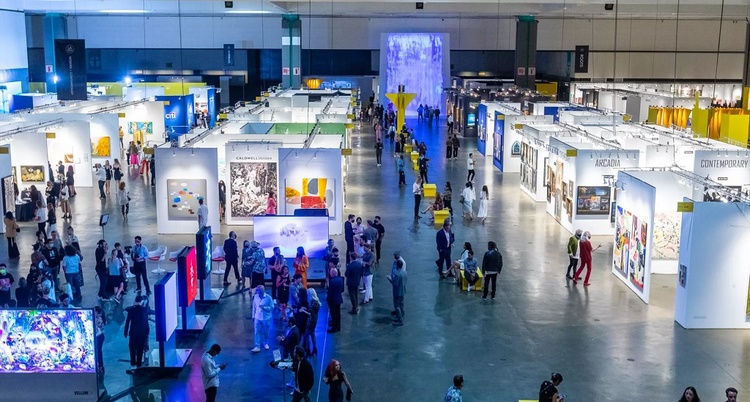
Although the LA Art Show—probably the most popular art fair in the United States—has featured a special section called DIVERSEartLA for several years, showcasing many Latin artists, what will happen now is unprecedented.
For this year's edition, taking place from January 7 to 11 at its usual location, the Los Angeles Convention Center, the event organizers have decided to present, for the first time, the Latin American Pavilion, an area of the festival specifically dedicated to Hispanic talent.
As expected, the space will be directed by Marisa Caichiolo, the Argentine curator whom we have interviewed on more than one occasion. She has been working with the LA Art Show since 2015 and, naturally, feels a strong affinity for the works created by our community.
In a press release, the organizers of the event state that the Latin American Pavilion will focus on memory, migration, and identity, and will undertake “a profound ancestral inquiry into the power dynamics in the representation of artists within the gallery system” with the aim of inviting the public to reconsider the origins, belonging, and ever-evolving future of Latin American art across borders.
“At a time when immigration issues continue to disproportionately affect Latin American communities, it is especially important to provide a platform for these artists,” Caichiolo states in the same text.
“Although their perspectives are vital for a more complete and equitable understanding of contemporary art, they remain underrepresented at major art fairs,” she adds. “This pavilion seeks to amplify their voices and affirm Latin America’s cultural and creative contributions on the global stage.”
The galleries invited to participate in this space include Artier Fine Art, which will present the exhibition “In the Mouth of the Jaguar: Reimagined Myths,” bringing together ten contemporary Latin American artists who explore, recover, and reconstruct the ancestral mythologies of the Americas.
The figure of the jaguar will be the starting point for a journey through the works of Natasha Grey (Mexico), Ender Martos (Venezuela), Dario Ortiz (Colombia), Moises Ortiz (Mexico), Luigi Fantini (Mexico), Brigitte Briones (Mexico), Ariel Vargassal (Mexico), Guillermo Bert (Chile), Miguel Osuna (United States), and Carlos Luna (Cuba).
For its part, Verse Gallery will present six artists, including Maquiamelo from Colombia, Esteban Jácome from Ecuador, Maca Vivas from Mexico, and Johnny López from Colombia, each with their own distinct style and artistic vision.
In other areas, the fair, celebrating its 31st year, will feature more than 90 exhibitors, including the Oliver Sears Gallery from Dublin, Provident Fine Art from Palm Beach, and the Pontone Gallery from London. There will be greater representation of British artists thanks to the LA Art Show debuts of the John Martin Gallery and Quantum Contemporary Art from London.
The jaguar will be the starting point for a journey through the works of Natasha Grey (Mexico), Ender Martos (Venezuela), Dario Ortiz (Colombia), Moises Ortiz (Mexico), Luigi Fantini (Mexico), Brigitte Briones (Mexico), Ariel Vargassal (Mexico), Guillermo Bert (Chile), Miguel Osuna (United States), and Carlos Luna (Cuba).
On the other hand, the Swiss gallery LICHT FELD will present the first public exhibition in over 40 years of woodcuts by Karl A. Meyer, a renowned Swiss sculptor and painter who has been particularly interested in Native American art.
Corridor Contemporary will exhibit the work of New York-based Israeli artist Yigal Ozeri, a practitioner of photorealism known for his large-scale portraits of young women set against lush landscapes.
There will also be a strong Korean presence with 15 participating galleries from that country, including J&J Art, which will present “Elegant Freedom,” an immersive work by Jinny Suh.
Source
Latest
Publications
- February 19, 2026
New Masters of Poster Design | Volume 1
News

Daily Artwork
- February 19, 2026
Time in the camps

Publications
Article
- February 19, 2026
Remedios Varo: Alchemical Surrealism in Mexico
Article
- February 19, 2026
Spatialism and Light in the Work of Lucio Fontana
Publications
- February 19, 2026
Steve McCurry Portraits
Publications
- February 19, 2026
HDR Photography Photo Workshop
Publications
- February 18, 2026
THE ESSENTIAL GUIDE TO LANDSCAPE PHOTOGRAPHY

- February 19, 2026
ARCO Madrid to Celebrate 45 Years with …

- February 17, 2026
Seven Free Art Exhibitions to Enjoy in …
- February 14, 2026
Remedios Varo and the Enduring Legacy o…
- February 10, 2026
Latin American Art Cultural Encounter f…

- February 08, 2026
A Bridge Between Latin American Art and…

- January 27, 2026
The exhibitions "From Tàpies to Siqueir…

- January 19, 2026
The Pulse of Art, Design, and Culture R…
- January 19, 2026
The Argentine museum celebrates 25 year…

- January 08, 2026
Latin American Pavilion Among the New A…

- January 07, 2026
Material Art Fair 2026

- January 05, 2026
The Latin American Pavilion Marks a Mil…

- December 31, 2025
the 10 million-dollar sales of 2025
- December 30, 2025
MALBA Doubles Collection and Reposition…
- December 29, 2025
The FEMSA Collection will celebrate its…

- December 25, 2025
“Ancestral Artist”: A Look at the Craft…

- December 25, 2025
Winner of the 13th Most Important Conte…
- December 25, 2025
Malba Acquires the Daros Latinamerica C…
- December 24, 2025
2026, a Key Year in Cultural Exchange B…

- December 23, 2025
Sacred Art Celebrates Christmas Through…
- December 22, 2025
MACA Inaugurates Exhibitions of Fontana…

- October 08, 2023
Illustrations reflect the brutal Israel…

- December 25, 2023
The jury statement of the Iran-Brazil F…
- March 21, 2024
The history of art in Palestine

- July 29, 2023
History of Caricature in Brazil
- September 01, 2023
Neural Filters in new photoshop 2023

- April 20, 2024
Poignant Image of Grief Wins Mohammed S…
- May 22, 2025
Brady Izquierdo’s Personal Exhibition O…
- February 18, 2024
7 Ways to Understand What Visual Arts A…

- October 21, 2023
Erick Meyenberg and Tania Ragasol at th…
- May 15, 2024
Eleven murals for Gaza painted across t…
- June 29, 2024
Exhibition at Centro MariAntonia contra…
- March 14, 2024
museum of statue of van gogh
- March 30, 2024
illustration websites in Latin America
- August 09, 2023
Venezuela mural expresses solidarity wi…
- May 25, 2025
Bordalo II to hold exhibition in Paris …
- March 15, 2024
museum of sculpture of Salvador Dali
- May 20, 2024
Latin American Festival of Performing A…
- July 30, 2024
The artist from San Luis Mirta Celi rep…

- January 23, 2025
Art Palm Beach 2025
- March 18, 2025
Works by Cuban Artist Eduardo Abela in …
- May 15, 2024
Eleven murals for Gaza painted across t…
- February 18, 2024
7 Ways to Understand What Visual Arts A…

- January 02, 2025
13 commemorations that will mark the cu…
- October 17, 2023
The influence of Latin American artists…
- February 03, 2024
THE HISTORY OF NAIF ART
- July 02, 2024
One of the largest urban art galleries …

- November 17, 2023
Fernando Botero's work is booming after…
- October 08, 2023
Illustrations reflect the brutal Israel…
- July 29, 2023
Piracicaba International Humor Exhibiti…
- December 25, 2023
The jury statement of the Iran-Brazil F…
- November 06, 2023
Heba Zagout: Palestinian artist murdere…

- December 10, 2023
Sliman Mansour and Palestinian art on t…
- March 14, 2024
museum of statue of van gogh
- February 01, 2025
A maior exposição de Botero em Barcelona
- March 21, 2024
The history of art in Palestine
- July 20, 2024
First International Mail Art Biennial 2…
- April 20, 2024
Poignant Image of Grief Wins Mohammed S…

- October 30, 2023
Palestinian turns images of the Gaza co…
- September 01, 2023
Neural Filters in new photoshop 2023

- February 08, 2024
Art Week 2024 in CDMX