Arnaldo Coen, a key figure in artistic experimentation in Mexico, has died
The National Institute of Fine Arts and Literature (INBAL) confirmed his passing via a post on social media.
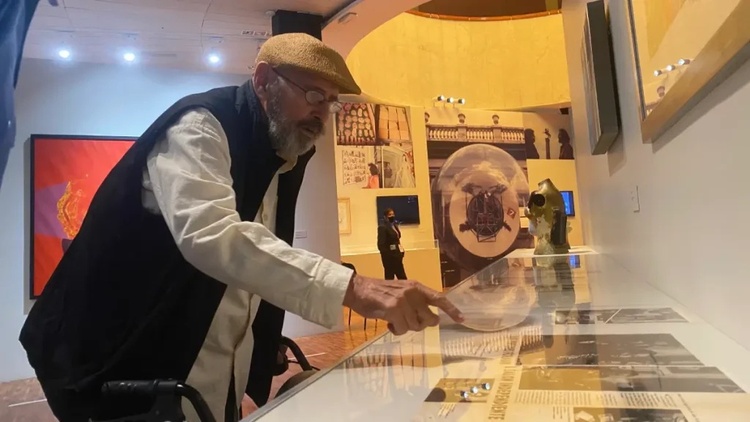
Visual artist Arnaldo Coen—a member of the *Ruptura* (Break) generation, a fellow of the Mexican Academy of Arts (AMA), and recipient of the 2014 National Prize for Sciences and Arts—died this Sunday at the age of 86.
The National Institute of Fine Arts and Literature (INBAL) confirmed his death through a social media post, in which it expressed its condolences to his family and friends.
Coen’s work is held in the collections of major cultural institutions, including INBAL’s Museum of Modern Art, the Museum of Contemporary Art (MUAC) at UNAM, the Museum of Latin American Art in California, and the San Francisco Museum of Modern Art.
The artist was also part of the *Salón Independiente* (Independent Salon) movement, which, between 1968 and 1970, brought together experimental creators who worked outside of established institutions and commercial galleries. The movement was notable for promoting collective artistic production. Coen participated in its third exhibition, *Tercer Salón Independiente*, in collaboration with the artist Sebastián.
He studied in Paris on a French government scholarship and was part of an artistic circle that gathered in Mexico City’s *Zona Rosa*—a group that included painters, gallery owners, actors, and theater and film directors.
As a member of this cultural milieu, he attended a party in the Lomas de Chapultepec neighborhood in February 1971, where he was arrested by the police alongside other members of the artistic community.
Among those present were Isela Vega, Arturo Vega Ruiz, and Alejandro Jodorowsky. The gathering was the target of a police raid, and the subsequent press coverage was intended to publicly expose and stigmatize the participants. The incident—referred to in the headlines of the time as a "raid on a hippie orgy"—was documented in the book *Redada en una fiesta hippie* ("Raid at a Hippie Party") by journalist Rafael Cabrera.
That same year, just three months after the *Rock y Ruedas* festival in Avándaro, Coen—along with his brothers Amílcar and Aristides—contributed to the visual and artistic design of *Prometo, espectáculo pop* ("I Promise: A Pop Spectacle"), a "happening" held at the Palace of Fine Arts (*Palacio de Bellas Artes*). The event featured professional wrestlers, fakirs, nude performers, and three musical groups: Dug Dug's, Peace & Love, and Javier Bátiz.
Deemed inappropriate for the venue, the show was interrupted by the police. Both the participants and the audience were forced to vacate the premises. As a result of this intervention, it was impossible to recover the materials used or the photographic records of the event.
Source
Latest
News
Article
- November 09, 2026
Art as Resistance: When Creation Transforms into Protest
Publications
- November 09, 2026
THE ANIMATOR’S WORKBOOK
Article
- November 09, 2026
Art in the Digital Age: Between Creative Freedom and Algorithms
Artist
- November 09, 2026
Eloín Rivera
Gallery
- November 09, 2026
Gallery Of Painting By Eloín Rivera - Colombia
Artist
- November 09, 2026
Lorenzo Gritti
Gallery
- November 09, 2026
Gallery Of Illustration By Lorenzo Gritti - Italy
Gallery
- November 09, 2026
Gallery of Typographic Posters by Studio Dobra – Portugal
- November 09, 2026
Arnaldo Coen, a key figure in artistic …

- November 08, 2026
MOLAA Celebrates 30 Years of Latin Amer…
- November 08, 2026
The Art Market in Madrid
- November 08, 2026
iPad Users Finally Get a Free Alternati…

- November 08, 2026
Quixel Megascans Becomes Free for Unlim…

- November 05, 2026
Newsweek: Politics – A Troubling Vision…

- November 05, 2026
he New Yorker Celebrates the Democrats’…
- October 31, 2026
35th Edition of arteba at La Rural
- October 31, 2026
The Art of Picasso, Klee, and Matisse A…
- October 29, 2026
Malba Announces the Acquisition of the …
- October 28, 2026
Art Basel Miami Beach 2026 Revamp
- October 28, 2026
Excitement Surrounds Frida Kahlo’s Work…
- October 27, 2026
Eduardo Costantini to be honored in New…
- October 26, 2026
Latin American Art Takes Center Stage a…

- October 25, 2026
Julio Cortázar Museum brings together w…
- October 04, 2026
MALBA in Buenos Aires Celebrates 25 Yea…
- August 26, 2026
The Passing of Sliman Mansour: An Artis…
- August 13, 2026
Botero Returns to New York to Revisit t…
- August 11, 2026
"Malba-Costantini Collection: Latin Ame…
- August 10, 2026
The Most Important Exhibition on the Me…

- October 08, 2023
Illustrations reflect the brutal Israel…
- December 25, 2023
The jury statement of the Iran-Brazil F…
- June 05, 2026
“Noise” Wins Award and Expands Internat…
- March 21, 2024
The history of art in Palestine

- July 29, 2023
History of Caricature in Brazil
- May 22, 2025
Brady Izquierdo’s Personal Exhibition O…
- April 20, 2024
Poignant Image of Grief Wins Mohammed S…
- September 01, 2023
Neural Filters in new photoshop 2023

- October 21, 2023
Erick Meyenberg and Tania Ragasol at th…
- May 15, 2024
Eleven murals for Gaza painted across t…
- June 29, 2024
Exhibition at Centro MariAntonia contra…
- February 18, 2024
7 Ways to Understand What Visual Arts A…
- March 30, 2024
illustration websites in Latin America
- March 14, 2024
museum of statue of van gogh
- May 25, 2025
Bordalo II to hold exhibition in Paris …
- June 03, 2026
Julio Le Parc, artist of light and move…
- March 15, 2024
museum of sculpture of Salvador Dali
- August 09, 2023
Venezuela mural expresses solidarity wi…
- May 20, 2024
Latin American Festival of Performing A…
- May 27, 2025
Works by Botero, Grau, and 80 other imp…
- May 15, 2024
Eleven murals for Gaza painted across t…
- February 18, 2024
7 Ways to Understand What Visual Arts A…
- February 03, 2024
THE HISTORY OF NAIF ART
- January 02, 2025
13 commemorations that will mark the cu…
- July 02, 2024
One of the largest urban art galleries …
- October 17, 2023
The influence of Latin American artists…
- October 08, 2023
Illustrations reflect the brutal Israel…

- November 17, 2023
Fernando Botero's work is booming after…
- July 29, 2023
Piracicaba International Humor Exhibiti…
- December 25, 2023
The jury statement of the Iran-Brazil F…
- November 06, 2023
Heba Zagout: Palestinian artist murdere…
- December 10, 2023
Sliman Mansour and Palestinian art on t…
- March 14, 2024
museum of statue of van gogh
- March 21, 2024
The history of art in Palestine
- February 01, 2025
A maior exposição de Botero em Barcelona
- February 08, 2024
Art Week 2024 in CDMX
- April 20, 2024
Poignant Image of Grief Wins Mohammed S…
- July 20, 2024
First International Mail Art Biennial 2…

- October 30, 2023
Palestinian turns images of the Gaza co…
- September 01, 2023
Neural Filters in new photoshop 2023