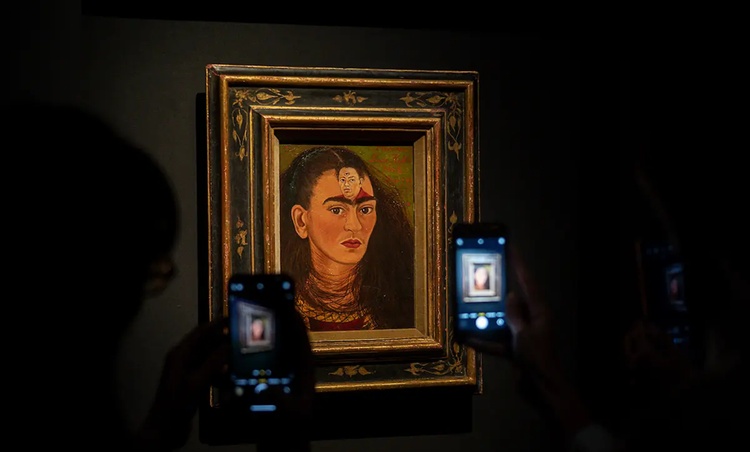
The Most Important Exhibition on the Mexican Artist Lands for the First Time
Frida Kahlo Arrives at MALBA: The Most Important Exhibition on the Mexican Artist Lands for the First Time
The Museum of Latin American Art of Buenos Aires will present "Viva Frida" in September, a groundbreaking exhibition that will bring together original pieces related to the Mexican artist.
The City of Buenos Aires will become one of the great cultural centers of Latin America with the arrival of "Viva Frida," the most important exhibition dedicated to Frida Kahlo, which will be hosted by the Museum of Latin American Art of Buenos Aires (MALBA), located in the Palermo neighborhood (Avenida Figueroa Alcorta 3415). This will be the first time the exhibition has been held in South America, marking a historic event and an unmissable opportunity. It will be open to the public from Saturday, September 19, at 7:00 p.m., until March 15, 2027.
The exhibition is part of the celebrations for the 25th anniversary of MALBA, organized by the Argentine Haute Couture Week (SAC), under the direction of Elina Costantini, together with the Frida Kahlo Museum in Mexico City, the institution responsible for preserving the painter's legacy in the iconic Blue House in Coyoacán.
More than an art retrospective, “Viva Frida” is a journey through the life of an artist who transformed pain, identity, and resistance into a form of creation. Through personal objects, photographs, letters, historical documents, clothing, accessories, and works related to her world, the public will discover little-known aspects of a figure who continues to inspire admiration worldwide.
Frida Kahlo, an artist who transcended art
To speak of Kahlo is to speak of one of the most influential personalities of the 20th century. Her work broke with the traditional molds of painting and transformed personal experience into a universal artistic language. Born in Coyoacán in 1907, she found in painting a way to express the profound transformations her life underwent. The aftereffects of polio during childhood and the serious car accident she suffered at age 18 forever marked her body and her artistic output. During her recovery, she began painting self-portraits that eventually became the hallmark of a deeply autobiographical body of work.
However, limiting her legacy to painting would be a mistake. Frida was also a politically engaged woman, a defender of Mexican cultural roots, and a figure who challenged gender stereotypes long before those debates occupied a central place on the public agenda. More than 70 years after her death (July 13, 1954), her image remains a symbol of resistance, creative freedom, and authenticity, inspiring and engaging new generations.
An exhibition that reveals the woman behind the myth
Unlike other exhibitions focused exclusively on her paintings, “Viva Frida” seeks to bring the public closer to the intimate world of the painter who captured her own reality. The exhibition will bring together more than 365 original pieces from the collection of the Frida Kahlo Museum in Mexico City: traditional dresses, jewelry, accessories, orthopedic corsets, medical devices, family photographs, correspondence, drawings, and historical documents that will allow visitors to better understand how the artist transformed her daily life into part of her work.
Each object will engage with Kahlo's artistic production and help reconstruct a personality that found in clothing, image, and self-portraiture a way to express ideas about the body, identity, politics, and Mexican culture. The exhibition will also explore the historical context in which the painter lived and the influence of both the Mexican Revolution and her relationship with Diego Rivera on the construction of her unique artistic identity.
Latest
Publications
- September 24, 2026
World of Art | Cave Art

Publications
Daily Artwork
- September 24, 2026
Gag Freedom in the USA.
Daily Artwork
- September 24, 2026
The Peace Table

Publications

Daily Artwork
- September 23, 2026
Ideas in Fugue
Publications
Publications
- September 22, 2026
Painting Imaginary Flowers
Publications
- September 22, 2026
Textiles in The Metropolitan Museum of Art
- August 26, 2026
The Passing of Sliman Mansour: An Artis…
- August 13, 2026
Botero Returns to New York to Revisit t…
- August 11, 2026
"Malba-Costantini Collection: Latin Ame…
- August 10, 2026
The Most Important Exhibition on the Me…

- August 06, 2026
Cau Gomez Launches Official Website
- July 04, 2026
Football and Art at Museo Jumex
- June 29, 2026
Gazan Art at the Palestinian Museum: "T…
- June 28, 2026
Works from the Venice Biennale at the E…
- June 27, 2026
A Frida Kahlo Retrospective Arrives at …

- June 11, 2026
Two Argentinians Selected for Internati…

- June 05, 2026
“Noise” Wins Award and Expands Internat…

- June 03, 2026
Julio Le Parc, artist of light and move…
- May 31, 2026
Latin American Art Arrives at the Museu…
- May 26, 2026
MPPM AT THE 5TH EDITION OF ART FOR PALE…

- May 25, 2026
Pro-Gaza Monument Gains Prominence in t…

- May 25, 2026
Botero Sold His First Painting for Two …
- May 24, 2026
MALBA Celebrates 25 Years

- May 23, 2026
Andrea Giunta presents her book “Lesson…
- May 21, 2026
Latin American Art Exhibition and Aucti…
- May 21, 2026
More than 120 works of Colombian and La…

- October 08, 2023
Illustrations reflect the brutal Israel…

- December 25, 2023
The jury statement of the Iran-Brazil F…

- March 21, 2024
The history of art in Palestine
- June 05, 2026
“Noise” Wins Award and Expands Internat…

- July 29, 2023
History of Caricature in Brazil
- September 01, 2023
Neural Filters in new photoshop 2023

- May 22, 2025
Brady Izquierdo’s Personal Exhibition O…

- April 20, 2024
Poignant Image of Grief Wins Mohammed S…

- October 21, 2023
Erick Meyenberg and Tania Ragasol at th…

- May 15, 2024
Eleven murals for Gaza painted across t…

- February 18, 2024
7 Ways to Understand What Visual Arts A…
- June 29, 2024
Exhibition at Centro MariAntonia contra…

- May 25, 2025
Bordalo II to hold exhibition in Paris …
- June 03, 2026
Julio Le Parc, artist of light and move…
- March 14, 2024
museum of statue of van gogh
- August 09, 2023
Venezuela mural expresses solidarity wi…
- March 30, 2024
illustration websites in Latin America
- March 15, 2024
museum of sculpture of Salvador Dali
- May 20, 2024
Latin American Festival of Performing A…

- October 30, 2023
Palestinian turns images of the Gaza co…
- May 15, 2024
Eleven murals for Gaza painted across t…
- February 18, 2024
7 Ways to Understand What Visual Arts A…

- January 02, 2025
13 commemorations that will mark the cu…
- February 03, 2024
THE HISTORY OF NAIF ART
- October 17, 2023
The influence of Latin American artists…

- July 02, 2024
One of the largest urban art galleries …

- November 17, 2023
Fernando Botero's work is booming after…
- July 29, 2023
Piracicaba International Humor Exhibiti…
- October 08, 2023
Illustrations reflect the brutal Israel…
- December 25, 2023
The jury statement of the Iran-Brazil F…
- November 06, 2023
Heba Zagout: Palestinian artist murdere…
- December 10, 2023
Sliman Mansour and Palestinian art on t…
- March 14, 2024
museum of statue of van gogh
- March 21, 2024
The history of art in Palestine
- February 01, 2025
A maior exposição de Botero em Barcelona
- July 20, 2024
First International Mail Art Biennial 2…

- February 08, 2024
Art Week 2024 in CDMX
- April 20, 2024
Poignant Image of Grief Wins Mohammed S…
- October 30, 2023
Palestinian turns images of the Gaza co…
- September 01, 2023
Neural Filters in new photoshop 2023