Marta Minujín, Six Decades as a Latin American “Art Guerrilla”
The Reina Sofía Museum in Madrid is opening the first retrospective focused on the performance work of Argentine artist Marta Minujín (Buenos Aires, 83 years old), with a reconstruction of La Menesunda (1965), the sensory labyrinth that scandalized Buenos Aires, in collaboration with Tate Liverpool and the Buenos Aires Museum of Modern Art. The exhibition will be open until March 8, 2027.
The original installation, co-created by Minujín and Rubén Santantonín, caused a scandal in 1965: the line to get in stretched all the way to Córdoba Avenue, and gossip magazines labeled them crazy. Sixty-one years later, the reconstruction occupies eleven spaces that are explored individually—a neon tunnel, a couple reading in bed, the inside of a head with a beauty salon, intestines, the inside of a refrigerator, and a giant telephone—and ends in “a whirlwind of confetti,” according to curator Manuel Segade.
The golden rule is individuality: one person enters every minute and a half so that the visitor feels “a little anguish” inside the entrails. Minujín explains that the title is due to the fact that Santantonín died in 1969, so what is seen is the work as she remembers it.
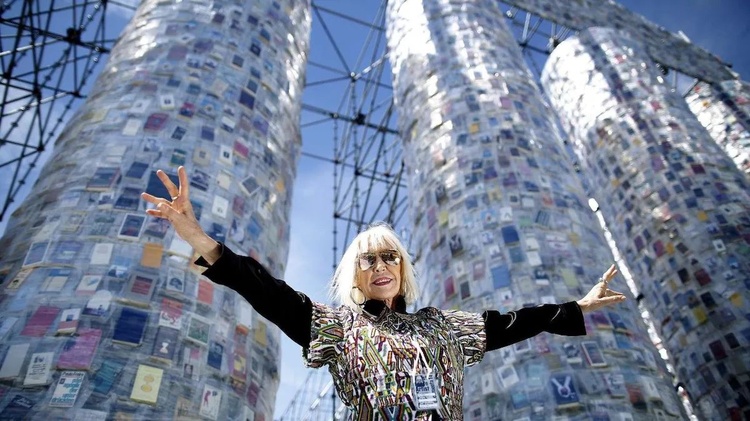
The retrospective also traces her career between 1963 and 1985: from La destrucción (1963), her first happening, to Simultaneidad en simultaneidad (1966) and Minuphone in New York. Also included is the symbolic payment of Argentina's foreign debt to Andy Warhol in 1985 with ears of corn, "Latin American gold," and his series The Fall of Universal Myths, featuring monuments made to be toppled: the Sweet Bread Obelisk (1979), the Joyce Tower covered in bread in Dublin, and the Parthenon of books banned by the dictatorship (1983), repeated at Documenta in Kassel in 2017 with more than one hundred thousand volumes.
Minujín defines herself as "an art guerrilla" rather than an activist. Regarding transgression today, she responds: "The creation of new myths," and criticizes the fact that the Statue of Liberty "no longer makes sense in a world that curtails freedoms." She mentions her unfinished project: a Statue of Liberty lying on its side and covered in hamburgers, which McDonald's declined to sponsor. Regarding Javier Milei, she was blunt: "A man who cares so little about art and culture doesn't affect us at all."
Segade emphasizes that the great performance pieces of the sixties “are just a rumor” and that this one can finally be experienced. Minujín sums it up: “In a museum, the public contemplates; here, it lives. It’s different to be a contemplator than to be a participant.”
Latest
News
- November 21, 2026
Morton Auctions Prepares for its Major Latin American
News
- November 21, 2026
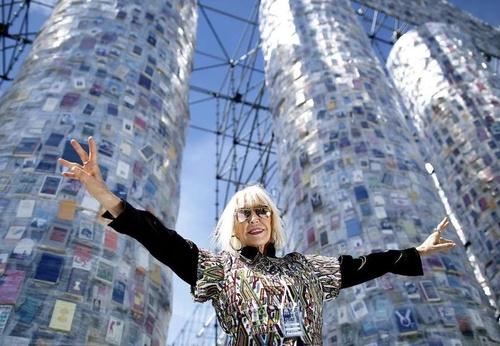
Marta Minujín, Six Decades as a Latin American “Art Guerrilla”
Article
- November 21, 2026
Printmaking: The Renaissance of Printmaking in the Digital World
Article
- November 21, 2026
Public Sculpture and Urban Memory: From Monument to Intervention
Artist
- November 21, 2026
Marcel Molina Martínez - Cuba
Gallery
- November 21, 2026
Gallery Of Illustration By Marcel Molina - Cuba
Article
- November 20, 2026
Back to the Canvas: Why Is Painting Still Alive in the Digital Age?
Article
- November 20, 2026
Contemporary Painting in Latin America
Contest
- November 20, 2026
20th Sony World Photography Awards 2027 – United Kingdom
- November 21, 2026
Morton Auctions Prepares for its Major …

- November 21, 2026
Marta Minujín, Six Decades as a Latin A…
- November 16, 2026
Latin American Art in Washington
- November 12, 2026
Mira Art Fair 2026
- November 12, 2026
Miguel Ángel Rojas at the Reina Sofía: …
- November 12, 2026
Two Artistic Dialogues Between France a…
- November 10, 2026
Beyond Exoticism: Latin American Art in…
- November 09, 2026
Arnaldo Coen, a key figure in artistic …

- November 08, 2026
MOLAA Celebrates 30 Years of Latin Amer…
- November 08, 2026
The Art Market in Madrid
- November 08, 2026
iPad Users Finally Get a Free Alternati…

- November 08, 2026
Quixel Megascans Becomes Free for Unlim…

- November 05, 2026
Newsweek: Politics – A Troubling Vision…

- November 05, 2026
he New Yorker Celebrates the Democrats’…

- October 31, 2026
35th Edition of arteba at La Rural
- October 31, 2026
The Art of Picasso, Klee, and Matisse A…
- October 29, 2026
Malba Announces the Acquisition of the …
- October 28, 2026
Art Basel Miami Beach 2026 Revamp
- October 28, 2026
Excitement Surrounds Frida Kahlo’s Work…

- October 27, 2026
Eduardo Costantini to be honored in New…

- October 08, 2023
Illustrations reflect the brutal Israel…

- December 25, 2023
The jury statement of the Iran-Brazil F…

- March 21, 2024
The history of art in Palestine

- June 05, 2026
“Noise” Wins Award and Expands Internat…

- July 29, 2023
History of Caricature in Brazil

- May 22, 2025
Brady Izquierdo’s Personal Exhibition O…
- April 20, 2024
Poignant Image of Grief Wins Mohammed S…
- September 01, 2023
Neural Filters in new photoshop 2023
- May 15, 2024
Eleven murals for Gaza painted across t…

- October 21, 2023
Erick Meyenberg and Tania Ragasol at th…
- February 18, 2024
7 Ways to Understand What Visual Arts A…
- June 29, 2024
Exhibition at Centro MariAntonia contra…
- March 30, 2024
illustration websites in Latin America
- March 14, 2024
museum of statue of van gogh

- May 25, 2025
Bordalo II to hold exhibition in Paris …
- June 03, 2026
Julio Le Parc, artist of light and move…
- March 15, 2024
museum of sculpture of Salvador Dali
- May 20, 2024
Latin American Festival of Performing A…
- August 09, 2023
Venezuela mural expresses solidarity wi…

- July 03, 2024
Newly discovered rock art in Venezuela
- May 15, 2024
Eleven murals for Gaza painted across t…
- February 18, 2024
7 Ways to Understand What Visual Arts A…
- February 03, 2024
THE HISTORY OF NAIF ART
- January 02, 2025
13 commemorations that will mark the cu…

- July 02, 2024
One of the largest urban art galleries …
- October 08, 2023
Illustrations reflect the brutal Israel…

- November 17, 2023
Fernando Botero's work is booming after…
- October 17, 2023
The influence of Latin American artists…
- July 29, 2023
Piracicaba International Humor Exhibiti…
- December 25, 2023
The jury statement of the Iran-Brazil F…
- November 06, 2023
Heba Zagout: Palestinian artist murdere…
- December 10, 2023
Sliman Mansour and Palestinian art on t…
- March 14, 2024
museum of statue of van gogh
- March 21, 2024
The history of art in Palestine
- February 01, 2025
A maior exposição de Botero em Barcelona
- April 20, 2024
Poignant Image of Grief Wins Mohammed S…

- February 08, 2024
Art Week 2024 in CDMX

- October 30, 2023
Palestinian turns images of the Gaza co…
- July 20, 2024
First International Mail Art Biennial 2…
- September 01, 2023
Neural Filters in new photoshop 2023